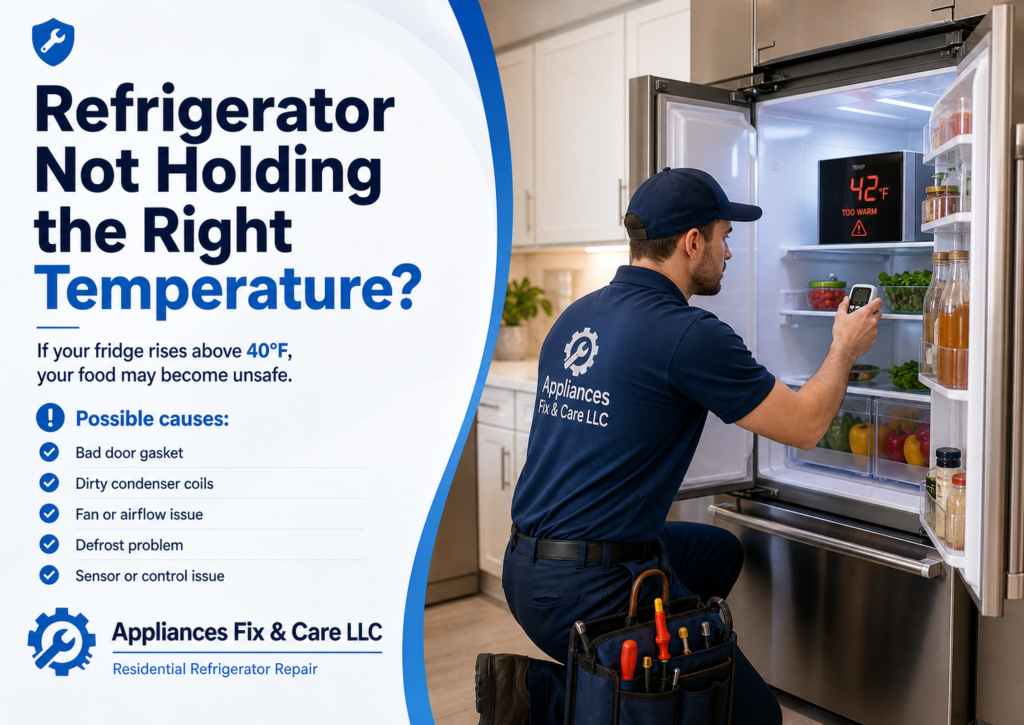
A refrigerator is supposed to keep food cold and safe. But when the temperature inside the refrigerator starts going up and down, especially when it rises above 40°F, the problem becomes more serious than just warm drinks or soft butter.
If your refrigerator is not holding the correct temperature, food can enter the temperature “danger zone.” That means bacteria may begin to grow faster, and some food may no longer be safe to eat. This is why a refrigerator that sometimes rises to 41°F, 42°F, 45°F, or higher should not be ignored.
At Appliances Fix & Care LLC, we repair residential refrigerators in Tampa, FL and help homeowners find the cause of cooling problems before they lead to spoiled food, repeat temperature swings, or bigger appliance damage.
Why 40°F Matters in a Refrigerator
For food safety, a refrigerator should stay at 40°F or below. The freezer should usually stay around 0°F.
When the refrigerator temperature rises above 40°F, especially for a long period of time, perishable food can become risky. This includes:
- Meat
- Poultry
- Fish and seafood
- Eggs
- Milk and dairy products
- Cooked leftovers
- Soft cheeses
- Prepared meals
- Cut fruit and vegetables
The problem is that food can look normal, smell normal, and still be unsafe. You cannot always tell by looking at it.
That is why temperature matters so much.
What Happens When a Refrigerator Goes Above 40°F?
If your refrigerator temperature rises above 40°F for a short moment and quickly comes back down, it may not always mean everything is ruined. But if the refrigerator stays above 40°F for too long, especially around two hours or more, perishable food may need to be discarded.
This can happen when:
- The refrigerator stops cooling overnight
- The door does not seal properly
- The compressor starts and stops incorrectly
- The evaporator fan is not circulating cold air
- The defrost system fails
- The temperature sensor gives incorrect readings
- The refrigerator is overloaded
- The condenser coils are dirty
- The control board is not managing the cooling cycle correctly
A refrigerator may still sound like it is running, but that does not mean it is cooling properly.
Common Signs Your Refrigerator Is Not Holding Temperature
You may notice several warning signs before the refrigerator completely fails.
Common signs include:
- The temperature display shows 41°F, 42°F, 45°F, or higher
- Food spoils faster than usual
- Milk smells bad before the expiration date
- The refrigerator feels cool sometimes and warm later
- The freezer works, but the refrigerator section is too warm
- Ice melts or becomes soft
- Water appears under drawers or shelves
- The refrigerator runs constantly
- The refrigerator turns on and off too often
- The back wall inside the refrigerator has frost or ice buildup
If the temperature keeps changing, the refrigerator needs to be checked. Waiting too long can cause more food loss and more expensive repairs.
Why a Refrigerator May Not Stay Cold
There are several possible reasons a refrigerator may not hold the correct temperature.
1. Dirty Condenser Coils
Condenser coils help remove heat from the refrigerator. When they are covered with dust, pet hair, grease, or debris, the refrigerator has to work harder.
This can cause weak cooling, longer run times, and temperature swings.
2. Bad Door Gasket
If the door gasket is torn, loose, dirty, or not sealing tightly, warm air enters the refrigerator. Even a small air leak can make the temperature rise above 40°F.
This problem is common when the refrigerator door does not close all the way or when the gasket has lost its shape.
3. Faulty Evaporator Fan
The evaporator fan moves cold air through the refrigerator. If the fan is weak, noisy, blocked, or not running, cold air may not reach the fresh food section.
You may notice that the freezer is cold, but the refrigerator side is warm.
4. Defrost System Problem
If the defrost system fails, ice can build up around the evaporator coil. When that happens, airflow becomes restricted and the refrigerator section may start warming up.
This issue can make the refrigerator cool normally at first, then slowly get warmer over time.
5. Bad Temperature Sensor or Thermistor
The temperature sensor tells the control board how cold the refrigerator is. If the sensor gives the wrong information, the refrigerator may stop cooling too early or run at the wrong time.
This can cause the temperature to rise even if the compressor and fans are still working.
6. Weak Compressor or Sealed System Issue
If the compressor is weak or there is a sealed system problem, the refrigerator may not be able to remove enough heat. This can cause slow cooling, unstable temperatures, or a refrigerator that never reaches the correct temperature.
This type of issue should be diagnosed by a professional technician.
7. Control Board Problem
Modern refrigerators depend on electronic control boards. If the board fails, it may not properly control the compressor, fans, defrost cycle, or sensors.
The result can be random cooling problems that come and go.
Why You Should Not Rely Only on the Refrigerator Display
Many homeowners look at the display on the refrigerator door and assume the temperature is correct. But the display may show the set temperature, not the real temperature inside the refrigerator.
For example, the panel may say 37°F, but the actual temperature near the food could be 42°F or higher.
The best way to check is to place an appliance thermometer inside the refrigerator and monitor the actual temperature over time.
What To Do If Your Refrigerator Goes Above 40°F
If you notice that your refrigerator temperature is above 40°F, take it seriously.
Here are a few steps you can take:
- Check if the door is fully closed.
- Make sure the gasket is sealing properly.
- Avoid opening the door repeatedly.
- Place a refrigerator thermometer inside.
- Check if the vents are blocked by food.
- Listen for the evaporator fan and compressor.
- If the temperature does not return to normal, schedule service.
If perishable food has been above 40°F for too long, follow food safety guidance. When there is doubt, it is usually safer to throw it out than risk illness.
When To Call for Refrigerator Repair
You should schedule refrigerator repair if:
- The temperature rises above 40°F more than once
- The refrigerator cannot stay between 35°F and 40°F
- Food is spoiling too quickly
- The freezer is cold but the refrigerator is warm
- The refrigerator runs constantly
- Ice or frost builds up inside
- The temperature changes during the day
- You hear clicking, buzzing, or unusual fan noises
A technician can test the fans, compressor, sensors, control board, defrost system, airflow, and door seal to find the real cause.
Refrigerator Repair in Tampa, FL
If your refrigerator is not holding the correct temperature, do not wait until more food spoils.
Appliances Fix & Care LLC provides residential refrigerator repair in Tampa, FL. We diagnose cooling problems, temperature issues, airflow problems, defrost failures, fan problems, compressor-related symptoms, and other common refrigerator issues.
A refrigerator that goes above 40°F may seem like a small problem at first, but it can quickly become a food safety issue and a costly appliance repair.
Schedule refrigerator service if your fridge is getting warm, not staying cold, or showing temperatures above 40°F.
FAQ
Why does my refrigerator temperature go above 40°F?
Your refrigerator may go above 40°F because of a bad door seal, dirty condenser coils, weak fan, defrost issue, faulty temperature sensor, control board problem, or compressor issue.
Is food safe if my refrigerator reached 42°F?
If the refrigerator only briefly reached 42°F and quickly cooled back down, the risk may be lower. But if perishable food stayed above 40°F for a long time, especially around two hours or more, food safety guidance may recommend throwing it away.
Why does my refrigerator say 37°F but feel warm inside?
The display may show the set temperature, not the real temperature inside. Airflow problems, bad sensors, blocked vents, or fan issues can cause the actual temperature near the food to be higher.
Can a bad door gasket make my refrigerator too warm?
Yes. A damaged or loose door gasket allows warm air to enter the refrigerator. This can cause the temperature to rise, the compressor to run longer, and food to spoil faster.
Should I repair my refrigerator if it sometimes gets warm but then cools again?
Yes. Intermittent cooling problems often get worse over time. A refrigerator that sometimes rises above 40°F should be diagnosed before it causes food loss or a complete cooling failure.