
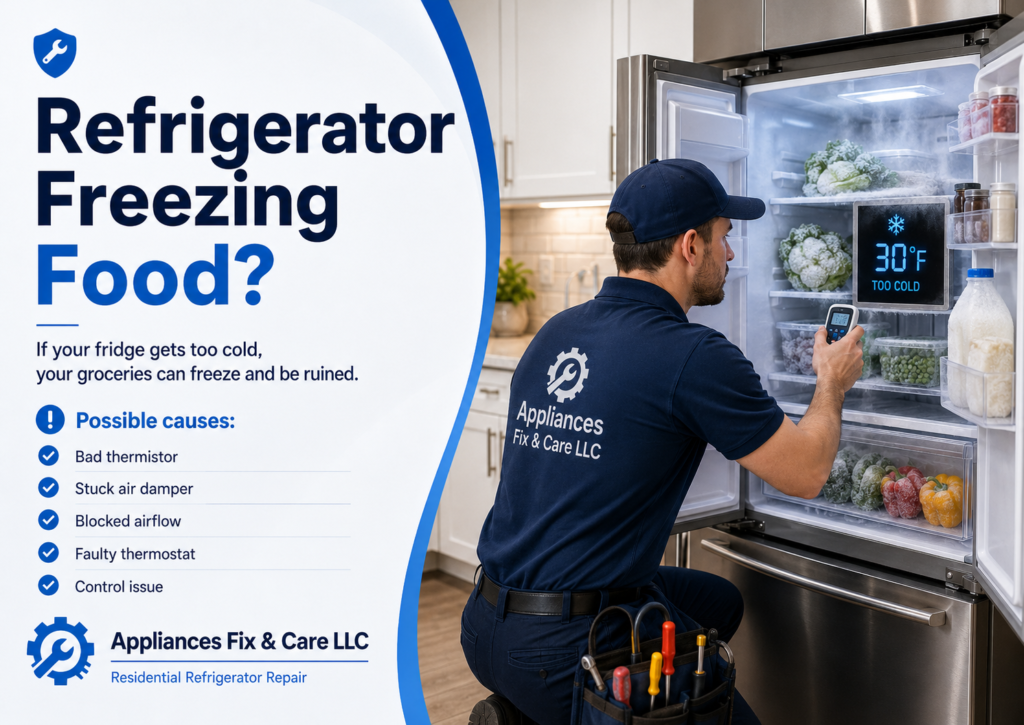
A refrigerator should keep food cold, but it should not freeze everything inside. If your milk, vegetables, eggs, drinks, or food containers are freezing inside the fresh food section, this is usually a sign that something is wrong.
Many homeowners think, “At least the refrigerator is cold.” But a refrigerator that freezes food is not working correctly. It can damage groceries, ruin fresh produce, crack bottles, and point to a deeper cooling or airflow problem.
At Appliances Fix & Care LLC, we provide residential refrigerator repair in Tampa, FL and help homeowners diagnose refrigerators that are getting too cold, freezing food, or not controlling temperature properly.
What Temperature Should a Refrigerator Be?
A normal refrigerator temperature is usually around 37°F to 40°F. That range helps keep food cold without freezing it.
If the fresh food section drops below freezing, items can start to freeze, especially:
- Vegetables
- Fruits
- Milk
- Eggs
- Yogurt
- Lettuce
- Bottled drinks
- Food near the back wall
- Items inside the crisper drawers
If your refrigerator is freezing food, the problem may be related to temperature control, airflow, sensors, or mechanical parts inside the refrigerator.
Common Signs Your Refrigerator Is Too Cold
You may notice several warning signs:
- Vegetables freezing in the crisper drawer
- Lettuce turning icy or watery
- Milk partially frozen
- Bottles or cans cracking
- Food near the back wall freezing
- Ice forming inside the fresh food section
- Temperature display showing normal, but food still freezes
- One side of the refrigerator colder than the other
- Refrigerator running too long
- Freezer working normally, but fridge section is too cold
These symptoms should not be ignored, especially if the problem keeps coming back.
Why Is My Refrigerator Freezing Food?
There are several reasons why a refrigerator may start freezing food.
1. Temperature Setting Is Too Low
The simplest cause is the temperature setting. Sometimes the refrigerator is accidentally set too cold.
If the setting is too low, the refrigerator may overcool the fresh food section and freeze items near the vents or back wall.
Before scheduling repair, check your temperature setting. A good starting point is usually around 37°F.
However, if the refrigerator is still freezing food even with the correct setting, there may be a mechanical or electronic problem.
2. Blocked Air Vents
Cold air usually enters the refrigerator section through air vents. If food is placed directly in front of those vents, the airflow can become uneven.
This can cause some areas to become too cold while other areas stay normal.
Common examples include:
- Food pushed against the back wall
- Large containers blocking vents
- Vegetables placed too close to cold air openings
- Overloaded shelves
- Poor air circulation inside the refrigerator
If only certain items are freezing, blocked airflow may be part of the problem.
3. Faulty Air Damper
Many refrigerators use an air damper to control how much cold air moves from the freezer into the refrigerator section.
If the damper gets stuck open, too much cold air enters the fresh food section. This can cause the refrigerator to become too cold and freeze food.
A bad damper can cause:
- Frozen food in the refrigerator section
- Very cold air blowing from vents
- Temperature swings
- Food freezing even when the setting looks normal
This is one of the common reasons a refrigerator freezes food.
4. Bad Temperature Sensor or Thermistor
Modern refrigerators use sensors to monitor internal temperature. If the temperature sensor, also called a thermistor, is not reading correctly, the refrigerator may think it is warmer than it really is.
When that happens, the control board may keep the cooling system running longer than needed.
The result: the refrigerator gets too cold and food starts freezing.
A faulty sensor can cause confusing symptoms because the display may look normal while the actual temperature inside the refrigerator is too low.
5. Faulty Thermostat
Some refrigerators use a thermostat to control cooling. If the thermostat fails, the refrigerator may not shut off at the right time.
This can cause the fresh food section to become colder and colder until food starts freezing.
Signs of a thermostat issue may include:
- Refrigerator running too long
- Food freezing throughout the fridge
- Temperature not matching the setting
- Cooling cycle not stopping normally
6. Control Board Problem
The control board is the “brain” of many modern refrigerators. It receives information from sensors and controls the compressor, fans, damper, and defrost system.
If the control board sends the wrong signal, the refrigerator may overcool the fresh food section.
A control board issue may cause:
- Random freezing
- Incorrect temperature control
- Intermittent cooling problems
- Refrigerator freezing food one day and acting normal the next
This type of problem usually requires professional diagnosis.
7. Evaporator Fan or Airflow Problem
The evaporator fan moves cold air through the refrigerator and freezer compartments. If the fan runs incorrectly or airflow is not balanced, the refrigerator may develop cold spots.
Cold spots can freeze food near certain shelves, vents, or drawers.
This is why some customers say:
“The refrigerator is freezing vegetables, but everything else seems fine.”
That usually means the cold air is not moving evenly.
8. Door Gasket or Door Closing Issue
A bad door gasket usually makes a refrigerator warmer, but in some cases it can also create temperature imbalance. If warm air enters the refrigerator, the system may run longer to compensate.
When the refrigerator runs longer than normal, certain areas near vents may become too cold and freeze food.
A damaged gasket can also cause frost, moisture, and uneven cooling.
Why Food Freezing in the Refrigerator Is a Problem
Food freezing inside the refrigerator can cause more than inconvenience.
It can lead to:
- Ruined vegetables
- Damaged fruit texture
- Frozen eggs or dairy
- Cracked bottles or cans
- Water leaks after items thaw
- Food waste
- Higher energy use
- Extra stress on refrigerator parts
A refrigerator that is too cold may also be a sign that one part is failing and another part is working harder than it should.
Why the Display May Show Normal Temperature
Many homeowners look at the refrigerator display and see 37°F or 38°F, but food is still freezing.
This can happen because the display may not show the real temperature in every area of the refrigerator. Some areas may be much colder than others, especially near vents, back walls, or drawers.
That is why a refrigerator can show a normal setting but still freeze food.
A technician can check the real temperature, airflow pattern, sensor readings, damper operation, fan operation, and control function.
What You Can Check Before Calling for Repair
Before scheduling service, you can try a few simple steps:
- Set the refrigerator temperature around 37°F to 40°F.
- Move food away from air vents.
- Do not overload shelves.
- Make sure the door closes fully.
- Check if the gasket is dirty, loose, or damaged.
- Place a refrigerator thermometer inside.
- Watch if food continues freezing over the next day.
If food keeps freezing after these steps, the refrigerator likely needs professional diagnosis.
When To Schedule Refrigerator Repair
You should schedule refrigerator repair if:
- Food keeps freezing even after adjusting the temperature
- Vegetables freeze in the crisper drawer
- Cold air is blowing too strongly from one area
- The refrigerator runs almost nonstop
- The temperature display does not match the real temperature
- The problem happens repeatedly
- You see ice or frost inside the fresh food section
- Bottles, cans, or food containers freeze and crack
A refrigerator that freezes food is not normal. The sooner the cause is found, the easier it may be to prevent more food waste and bigger appliance issues.
Refrigerator Repair in Tampa, FL
If your refrigerator is freezing food, vegetables, drinks, or items in the crisper drawer, Appliances Fix & Care LLC can help.
We provide residential refrigerator repair in Tampa, FL and diagnose common refrigerator temperature problems, including airflow issues, faulty dampers, bad sensors, thermostat problems, control board issues, and cooling system concerns.
If your fridge is too cold or freezing food inside the refrigerator section, schedule service before more groceries are wasted.
FAQ
Why is my refrigerator freezing food?
Your refrigerator may be freezing food because the temperature is set too low, air vents are blocked, the air damper is stuck open, the temperature sensor is bad, the thermostat is faulty, or the control board is not controlling cooling correctly.
Why are vegetables freezing in my refrigerator drawer?
Vegetables may freeze in the crisper drawer because of cold air entering the drawer area, blocked airflow, incorrect temperature settings, or a faulty damper or sensor.
Why is my fridge freezing food even on the correct setting?
If your refrigerator is set correctly but still freezes food, the issue may be with the thermistor, thermostat, air damper, control board, evaporator fan, or airflow system.
Is frozen food in the refrigerator safe to eat?
Some food may still be safe if it froze, but the quality can be damaged. Vegetables, fruits, dairy, and eggs may change texture or become unusable. If food safety is uncertain, it is better to be careful.
Can a bad sensor make a refrigerator freeze food?
Yes. A bad temperature sensor can send incorrect information to the control board. The refrigerator may keep cooling even when it is already cold enough.
Should I call a technician if my refrigerator freezes food?
Yes, especially if the problem happens repeatedly. A technician can test the sensors, damper, thermostat, fan, control board, airflow, and temperature performance.