
It can be confusing when your refrigerator section feels normal, but the freezer is not freezing properly. The milk is cold, the drinks feel fine, but the ice cream is soft, food is thawing, or the freezer temperature is too high.
For many homeowners in Tampa, FL, this problem is not just an inconvenience. In Florida heat, a freezer that is not holding the right temperature can quickly lead to spoiled food, water leaks, ice buildup, and a more expensive repair if the issue is ignored.
At Appliances Fix & Care, we often get calls from customers saying:
“My refrigerator is cooling, but the freezer is not freezing.”
This problem can happen for several real reasons. Some are simple, like dirty condenser coils or a freezer door not sealing properly. Others are more serious, like a sealed system issue, a refrigerant leak, a frozen evaporator coil, or a failing compressor.
Let’s break down the most common causes.
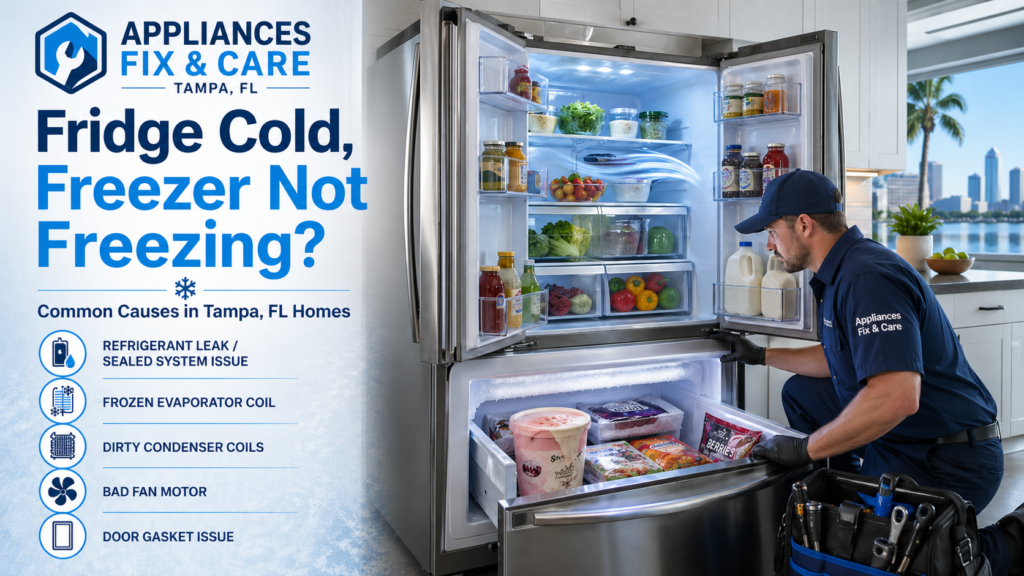
What Temperature Should Your Refrigerator and Freezer Be?
A normal refrigerator temperature is usually around 37°F to 40°F.
A normal freezer temperature should be around 0°F.
This is important because the freezer has to work much harder than the refrigerator section. Your refrigerator may still feel cold enough for drinks and food, but the freezer may not be cold enough to freeze meat, ice, or ice cream.
That is why a refrigerator can sometimes appear to be “working,” while the freezer is already showing signs of a cooling problem.
Why the Fridge Can Stay Cold While the Freezer Does Not Freeze
In some refrigerators, especially newer French door and dual cooling models, the refrigerator and freezer sections may have separate airflow control, sensors, or even separate evaporator systems.
In other models, the freezer is the main cooling source, and cold air is shared with the refrigerator section. In that case, if the freezer is not freezing, the refrigerator may still feel normal for a short time, but eventually the fresh food section may also start getting warmer.
So if your fridge is cold but your freezer is not freezing, it does not mean the refrigerator is fine. It usually means the problem is starting in one part of the cooling system and needs to be diagnosed.
1. Low Refrigerant or Refrigerant Leak
One serious cause is a refrigerant leak.
Many homeowners still call it a “Freon leak,” even though many modern refrigerators use different types of refrigerant. The idea is the same: the sealed system does not have enough refrigerant to remove heat properly.
When the refrigerant level is low, the refrigerator may still cool the fresh food section enough to feel normal, but the freezer may not reach the deep freezing temperature it needs.
Common signs of a possible refrigerant leak include:
- Freezer is cool but not freezing.
- Ice cream stays soft.
- Compressor runs for a long time.
- Freezer temperature does not reach 0°F.
- Only part of the evaporator coil has frost.
- Refrigerator slowly gets worse over time.
This is not a DIY repair. Refrigerant leaks require proper tools, sealed system knowledge, leak detection, vacuuming, and charging the system correctly.
If your freezer is not freezing but the refrigerator still feels cold, a low refrigerant charge is one possible cause, but it must be confirmed by a technician.
2. Frozen Evaporator Coil
Another common reason is a frozen evaporator coil.
The evaporator coil is the part inside the refrigerator or freezer that gets cold. If it becomes covered with thick ice, air cannot move through it properly. The system may still be running, but the cold air cannot circulate where it needs to go.
A frozen evaporator coil can be caused by:
- Bad defrost heater.
- Bad defrost thermostat.
- Bad defrost sensor.
- Failed control board.
- Freezer door not closing fully.
- Damaged door gasket.
- Warm air entering the freezer.
- Drain or airflow restriction.
When the coil is frozen, the freezer may become warmer even though the refrigerator is still trying to cool. You may also hear the fan making noise if ice is hitting the fan blade.
Signs of a frozen evaporator coil include:
- Frost or ice buildup on the back panel inside the freezer.
- Freezer fan noise.
- Weak airflow.
- Freezer not freezing.
- Refrigerator temperature changing up and down.
- Water leaking after ice melts.
A frozen coil is not always the root problem. It is often a symptom. The real issue may be in the defrost system, airflow, gasket, sensor, or control board.
3. Dirty Condenser Coils
Dirty condenser coils are very common in Florida homes.
The condenser coils help the refrigerator release heat. When they are covered with dust, pet hair, grease, or lint, the refrigerator cannot remove heat efficiently.
In Tampa, this can be worse because garages, kitchens, humidity, pets, and dust can all make the system work harder.
Dirty condenser coils can cause:
- Freezer not freezing properly.
- Refrigerator running constantly.
- Compressor overheating.
- Higher electric bills.
- Shorter compressor life.
- Weak cooling during hot weather.
Sometimes the refrigerator section may still feel cold, but the freezer struggles to reach 0°F.
Cleaning the condenser is basic maintenance, but it must be done carefully. Some coils are behind the refrigerator, some are underneath, and some are difficult to access without removing panels.
4. Bad Evaporator Fan Motor
The evaporator fan moves cold air through the freezer and, in many models, toward the refrigerator section.
If the freezer fan is weak, blocked, noisy, or completely dead, the freezer may not freeze correctly.
Signs of a bad evaporator fan include:
- Freezer is not freezing evenly.
- Fan noise from inside the freezer.
- No airflow when the freezer door switch is pressed.
- Ice buildup near the fan.
- Refrigerator temperature may still seem okay at first.
- Freezer gets cold in one area but not another.
Sometimes the fan itself is bad. Other times the fan is blocked by ice, which means the technician also needs to find out why ice formed there.
5. Condenser Fan Failure
The condenser fan helps cool the compressor and condenser coils. If this fan stops working, the refrigerator may overheat and lose cooling efficiency.
This can cause the freezer to become too warm, especially in Florida homes where the kitchen or garage area may already be hot.
Signs of a condenser fan problem include:
- Refrigerator feels hot around the back or bottom.
- Compressor is very hot.
- Freezer is not freezing.
- Refrigerator runs constantly.
- Clicking or overheating symptoms.
A bad condenser fan should not be ignored because it can damage the compressor over time.
6. Weak Compressor or Start Relay Problem
The compressor is the heart of the cooling system. If it is weak, overheating, or not starting properly, the freezer may not get cold enough.
Sometimes the problem is not the compressor itself, but the start relay, overload, capacitor, inverter board, or control board that helps the compressor run.
Signs may include:
- Clicking sound from the back of the refrigerator.
- Compressor tries to start and shuts off.
- Freezer is warm.
- Refrigerator cooling is weak.
- Unit runs too long.
- Freezer temperature keeps rising.
This type of problem requires proper testing. Replacing parts without diagnosis can become expensive and may not solve the issue.
7. Freezer Door Gasket or Door Not Closing Properly
Sometimes the problem is not inside the sealed system at all. It can be as simple as a freezer door that does not seal properly.
If warm air enters the freezer, the freezer cannot maintain 0°F. This can also cause frost, ice buildup, and water leaks.
Common reasons include:
- Damaged freezer gasket.
- Food blocking the drawer or door.
- Freezer basket not aligned.
- Ice buildup preventing full closure.
- Door rail problem.
- Drawer not closing all the way.
- Gasket not sealing in one corner.
This is especially common on bottom freezer and French door refrigerators.
A small air leak can create a big cooling problem.
8. Blocked Air Vents or Overpacked Freezer
Airflow matters.
If the freezer is packed too tightly, cold air cannot circulate properly. This can make some areas cold and other areas too warm.
Blocked vents can cause:
- Uneven freezing.
- Soft ice cream.
- Frost buildup.
- Refrigerator temperature changes.
- Freezer struggling to recover after opening.
This is one of the simpler causes, but if the freezer continues to struggle after airflow is corrected, there may be a deeper issue.
9. Bad Temperature Sensor or Thermistor
Modern refrigerators use sensors to read temperature and tell the control board when to cool.
If a freezer sensor or thermistor gives the wrong reading, the refrigerator may think the freezer is cold enough when it is not.
Signs of a sensor problem may include:
- Freezer temperature does not match the display.
- Refrigerator turns off too early.
- Freezer temperature changes randomly.
- No obvious frost or airflow problem.
- Error codes on some models.
A technician can test the sensor resistance and compare it to the manufacturer’s specifications.
10. Control Board or Inverter Board Issue
Many newer refrigerators depend on electronic control boards. These boards control fans, compressor speed, defrost cycles, sensors, and dampers.
If the board is not sending the correct signal, the freezer may stop freezing even though some parts of the refrigerator still work.
Possible signs include:
- Fans not turning on.
- Compressor not running correctly.
- Display works but cooling is weak.
- Random temperature problems.
- Defrost cycle not working.
- Error codes.
Board issues should be diagnosed carefully because control boards can be expensive.
Should You Unplug the Refrigerator or Let It Keep Running?
If your freezer is not freezing, do not keep opening the doors to check it every few minutes. That only lets more warm air in.
You can check:
- Is the freezer door fully closed?
- Is the gasket sealing?
- Is the freezer overpacked?
- Is there frost on the back wall?
- Is the condenser area very dirty?
- Is the fan making noise?
- Is the compressor running?
But if food is thawing or the freezer temperature is rising, it is better to schedule refrigerator repair before the problem becomes worse.
When to Call a Refrigerator Repair Technician in Tampa, FL
You should call a technician if:
- The freezer is not freezing after several hours.
- Ice cream is soft.
- Meat or frozen food is thawing.
- You see ice buildup on the back freezer wall.
- The refrigerator runs constantly.
- The compressor is hot.
- You hear clicking from the back.
- The freezer temperature is above 10°F to 20°F.
- The problem keeps coming back after defrosting.
A proper diagnosis can save money because the same symptom can have many different causes.
For example, “freezer not freezing” can be caused by a refrigerant leak, a fan motor, a defrost failure, a dirty condenser, a bad gasket, a weak compressor, or a control board issue.
Guessing is expensive. Testing is better.
Refrigerator Repair in Tampa, FL
f your refrigerator is cold but your freezer is not freezing, Appliances Fix & Care can help diagnose the problem and explain the repair options clearly.
We provide residential refrigerator repair in Tampa, FL and surrounding areas. Whether the issue is poor airflow, frozen coils, dirty condenser coils, a fan problem, a sealed system issue, or an electronic control problem, we can inspect the unit and let you know what is really happening.
FAQ
Why is my refrigerator cold but my freezer not freezing?
This can happen because the freezer needs a much lower temperature than the refrigerator section. Common causes include low refrigerant, a frozen evaporator coil, dirty condenser coils, bad fans, door gasket leaks, sensor problems, or a weak compressor.
Can low refrigerant make the freezer stop freezing while the fridge still works?
Yes. In some cases, low refrigerant can still provide enough cooling for the refrigerator section but not enough to bring the freezer down to 0°F. This usually requires professional sealed system diagnosis.
Can dirty condenser coils cause the freezer not to freeze?
Yes. Dirty condenser coils make it harder for the refrigerator to release heat. This can reduce cooling efficiency and cause the freezer to struggle, especially in warm Florida homes.
Why is there frost on the back wall of my freezer?
Frost on the back wall often means the evaporator coil may be frozen. This can be caused by a defrost system failure, bad sensor, bad heater, control board issue, air leak, or door gasket problem.
Is it worth repairing a refrigerator that is not freezing?
It depends on the cause, age, brand, and condition of the refrigerator. Fan, gasket, sensor, defrost, and condenser issues are often repairable. Sealed system or compressor issues can be more expensive and need proper evaluation.